Six-Degree-of-Freedom Platform Custom

Home / Products / Multi-Degree of Freedom Platform / Six-Degree-of-Freedom Platform

About Us
Suzhou Tongyousheng Electronic Technology Co., Ltd.

Suzhou Tongyousheng Electronic Technology Co., Ltd. is a leading high-tech enterprise integrating R&D, production and sales, specializing in the design, manufacturing and distribution of premium automation equipment and components—including electric cylinders, linear slide modules, linear motor modules, servo presses, robotic 7th axes, and six-degree-of-freedom platforms.

As China Six-Degree-of-Freedom Platform Manufacturers and Six-Degree-of-Freedom Platform Suppliers, we recognize technological innovation as the cornerstone of sustainable growth. Our R&D team, composed of industry veterans with deep technical expertise and extensive hands-on experience, serves as the engine driving our continuous progress. By pushing technical boundaries, accelerating product iteration, and pioneering industry advancements, we have secured a portfolio of core patents that underscore our leadership in automation and deliver a decisive competitive edge. We further reinforce our capabilities with state-of-the-art R&D tools, professional design software, and high-precision CNC machining centers, ensuring every development effort is backed by world-class resources.

Through years of relentless exploration and execution, Tongyousheng has established itself as an industry benchmark, renowned for its robust R&D, cutting-edge products, and uncompromising quality. We are dedicated to advancing the Industry 4.0 revolution, collaborating with state-owned enterprises, defense technology institutions, and top-tier universities to build a deeply integrated ecosystem of industry, academia, and research—pushing the frontiers of intelligent manufacturing together. At the heart of our mission is a commitment to delivering automation solutions that are intuitive to operate, highly efficient, ultra-reliable, and cost-effective. Every product we create is a reflection of our technical ingenuity and a direct response to our customers' evolving needs.
Certificate Of Honor
  • ISO 9001:2015 Certificate
  • High-tech Enterprise Certificate
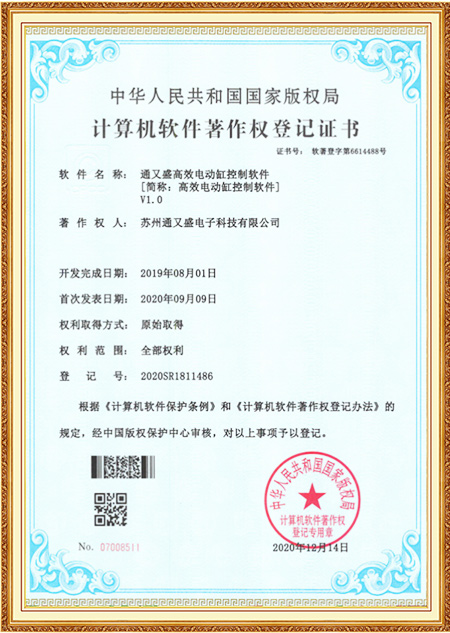
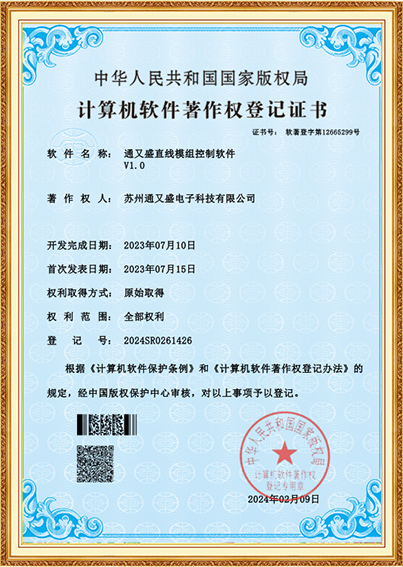
  • Copyright Certificate
  • Copyright Certificate
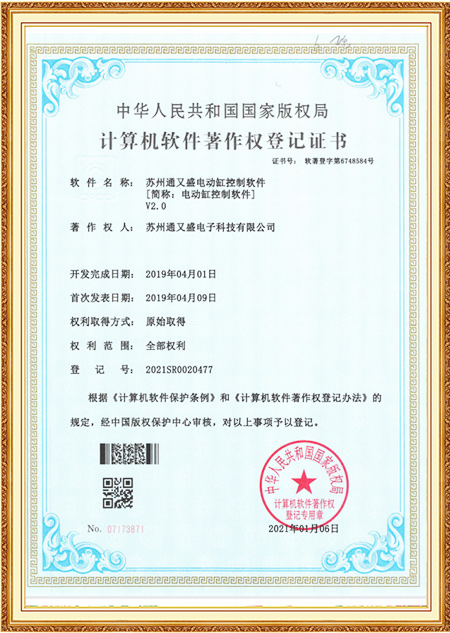
  • Software Copyright Certificate
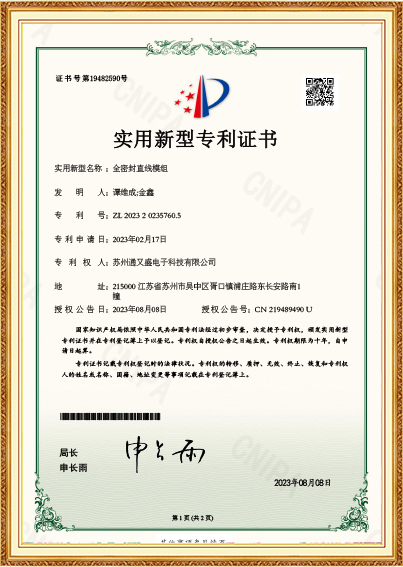
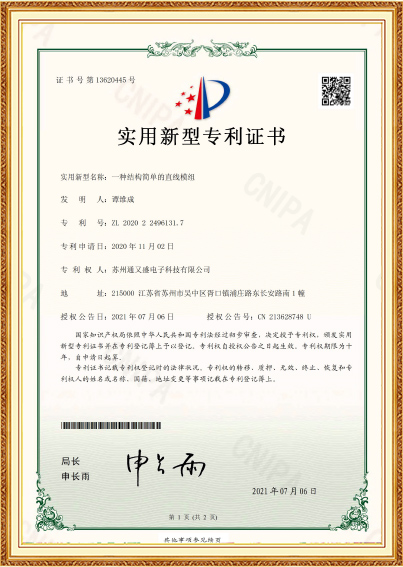
  • Patent Certificate
  • Patent Certificate
  • Patent Certificate
Message Feedback
Blog
Six-Degree-of-Freedom Platform Industry knowledge

Why Six Struts Instead of Six Stacked Axes, and What a Spec Sheet Leaves Out

A Question That Comes Up the First Time Someone Sketches an Alternative

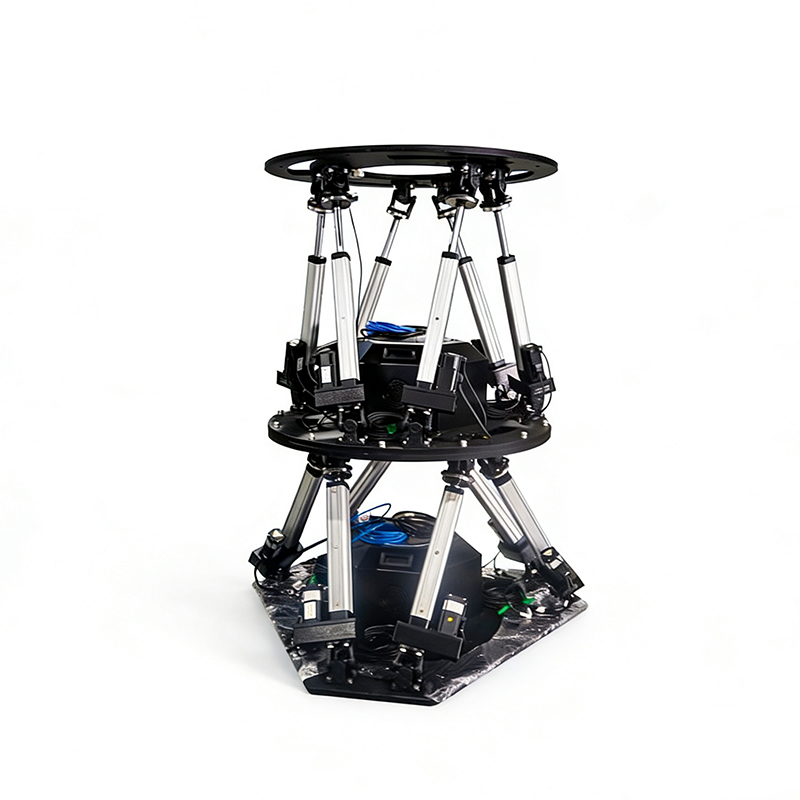
Almost every engineer who first encounters a six-degree-of-freedom platform asks some version of the same thing: why not just stack six single-axis stages on top of one another, one for each direction of motion, instead of building this parallel strut arrangement that looks mechanically more complicated? The answer has less to do with tradition and more to do with what happens to positioning error and structural stiffness once you start piling axes on top of each other rather than arranging them in parallel around a shared moving platform.

What Stacking Axes Actually Costs You

In a serial stack — X stage on Y stage on Z stage, then three rotational stages layered further up — each axis carries the full weight and error budget of every axis above it. Positioning error accumulates additively through the stack, so the topmost axis inherits backlash, thermal drift, and structural deflection from every stage beneath it. The physical height of the assembly grows with each added axis, which pushes the center of mass further from the base and increases overturning moment under any lateral load. A six-degree-of-freedom platform built this way would end up tall, mechanically compliant at the top, and burdened with cumulative error that no single-axis calibration can fully remove, since the error at the top depends on the combined state of everything below it.

How the Parallel Strut Arrangement Changes the Loading Picture

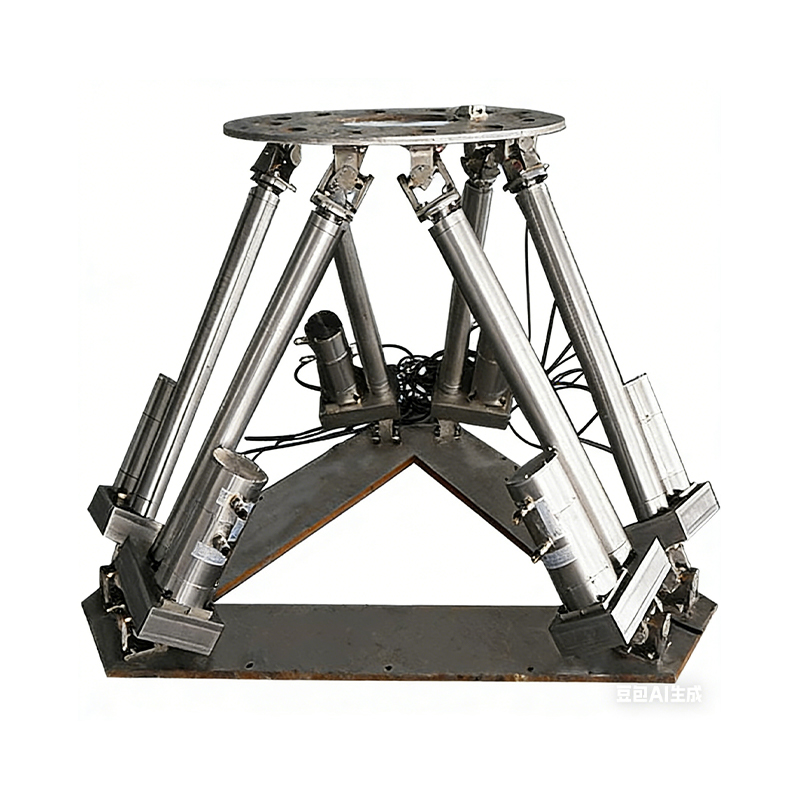
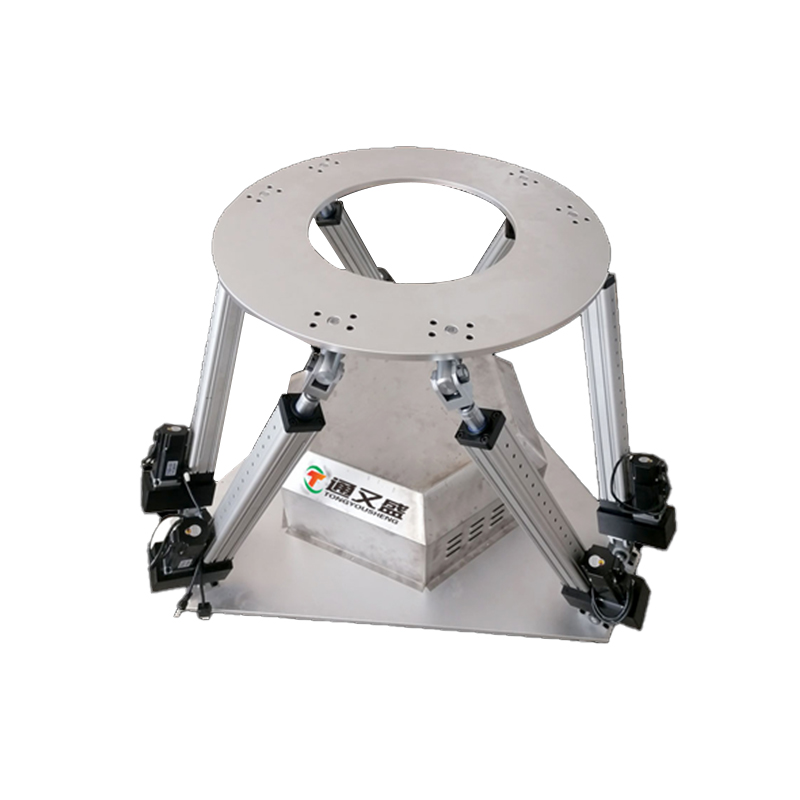
A Stewart-type platform connects the moving plate to the base through six struts arranged so that each one shares a portion of the total load, rather than one axis bearing the weight of everything above it. This distributes structural load across six load paths simultaneously instead of concentrating it through a single tall stack, which keeps the overall structure lower and stiffer for a given footprint. Positioning error in a parallel arrangement does not simply add up axis by axis — it depends on the combined geometry of all six struts computed through the platform's kinematic solution, which is a more complex calculation but tends to produce a structure with better stiffness-to-mass ratio than an equivalent serial stack. Suzhou Tongyousheng Electronic Technology Co., Ltd. builds this structural reasoning into how strut length, joint placement, and base geometry get specified for a given payload and motion envelope, since the parallel arrangement only delivers its stiffness advantage if the strut geometry is actually matched to the expected load case.

The Trade-Off That Comes With This Structure

None of this comes free — a parallel platform's working envelope is inherently more limited than a serial stack's, since strut length and joint articulation range constrain how far the moving plate can travel or rotate before a strut reaches a mechanical or kinematic limit. Singularities, points in the workspace where the platform loses controllability in one or more directions, are also a consideration unique to parallel mechanisms and need to be mapped out and avoided during motion planning rather than simply trusted to the controller at runtime.

Serial stack (axis on axis) Error accumulates additively up the stack Taller structure, larger overturning moment
Parallel strut arrangement Error depends on combined strut geometry, not simple addition Lower profile, higher stiffness per unit mass
Both approaches Require accurate joint and mounting point calibration Neither tolerates unverified assembly tolerances well

Why Payload and Stroke Numbers Only Tell Part of the Story

Once the structural case for a parallel platform is settled, the next question a buyer runs into is what else, besides payload capacity and stroke range, actually determines whether a supplier's platform will perform as expected in a real application. Controller update rate matters more than it looks on paper — a platform capable of a wide motion envelope mechanically can still feel sluggish or imprecise if the control loop closing all six axes runs at an update rate too slow for the intended dynamic response. Strut drive type also affects long-term behavior differently: ball-screw driven struts tend to offer higher stiffness but lower top speed, while linear-motor-driven struts trade some stiffness for faster dynamic response, and which one suits a given application depends heavily on whether the use case prioritizes static load holding or rapid motion profile tracking.

System-Level Capabilities That Rarely Appear on a Headline Spec Sheet

Calibration methodology is another area worth probing directly rather than assuming from a datasheet — whether a supplier verifies joint coordinates with a laser tracker or coordinate measuring equipment before computing the kinematic transform, or instead relies on nominal design values and corrects for error later in software, produces platforms with meaningfully different real-world accuracy even if their catalog specifications read identically. Thermal behavior of the strut actuators under sustained load also deserves attention, since thermal expansion in a strut changes its effective length slightly, and on a parallel mechanism this shows up as a small but real drift in platform pose rather than a localized single-axis error. Suzhou Tongyousheng Electronic Technology Co., Ltd. treats these calibration and thermal-compensation questions as part of the technical conversation with customers sizing a six-degree-of-freedom platform for motion simulation, vibration testing, or precision alignment work, since payload rating alone does not indicate how the platform holds its calibrated accuracy once it has been running for several hours under load.