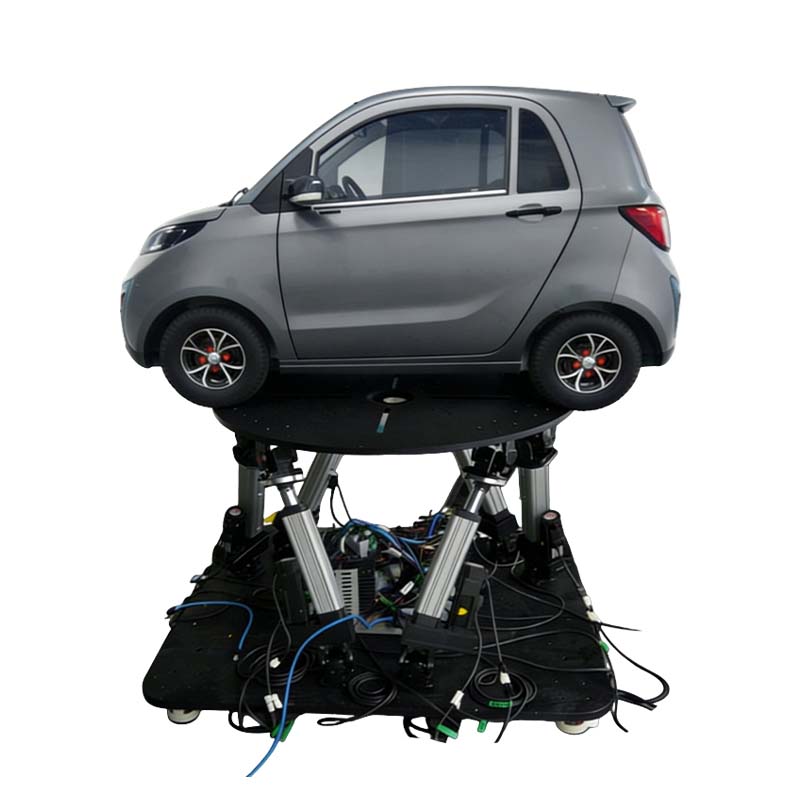
Vehicle Dynamic Test Platform Custom

Home / Products / Motion Simulation Platform / Vehicle Dynamic Test Platform

About Us
Suzhou Tongyousheng Electronic Technology Co., Ltd.

Suzhou Tongyousheng Electronic Technology Co., Ltd. is a leading high-tech enterprise integrating R&D, production and sales, specializing in the design, manufacturing and distribution of premium automation equipment and components—including electric cylinders, linear slide modules, linear motor modules, servo presses, robotic 7th axes, and six-degree-of-freedom platforms.

As China Vehicle Dynamic Test Platform Manufacturers and Vehicle Dynamic Test Platform Suppliers, we recognize technological innovation as the cornerstone of sustainable growth. Our R&D team, composed of industry veterans with deep technical expertise and extensive hands-on experience, serves as the engine driving our continuous progress. By pushing technical boundaries, accelerating product iteration, and pioneering industry advancements, we have secured a portfolio of core patents that underscore our leadership in automation and deliver a decisive competitive edge. We further reinforce our capabilities with state-of-the-art R&D tools, professional design software, and high-precision CNC machining centers, ensuring every development effort is backed by world-class resources.

Through years of relentless exploration and execution, Tongyousheng has established itself as an industry benchmark, renowned for its robust R&D, cutting-edge products, and uncompromising quality. We are dedicated to advancing the Industry 4.0 revolution, collaborating with state-owned enterprises, defense technology institutions, and top-tier universities to build a deeply integrated ecosystem of industry, academia, and research—pushing the frontiers of intelligent manufacturing together. At the heart of our mission is a commitment to delivering automation solutions that are intuitive to operate, highly efficient, ultra-reliable, and cost-effective. Every product we create is a reflection of our technical ingenuity and a direct response to our customers' evolving needs.


Certificate Of Honor
  • ISO 9001:2015 Certificate
  • High-tech Enterprise Certificate
  • Copyright Certificate
  • Copyright Certificate
  • Software Copyright Certificate
  • Patent Certificate
  • Patent Certificate
  • Patent Certificate
Message Feedback
Blog
Vehicle Dynamic Test Platform Industry knowledge

Chasing Down Data Drift on a Vehicle Dynamic Test Platform Without Guessing

A Durability Program That Runs for Months, Not Minutes

Most equipment gets judged on how it performs during a demonstration. A vehicle dynamic test platform gets judged on how it performs during month four of an eighteen-month durability program running the same load spectrum tens of thousands of times over. That difference in duty cycle changes what actually matters in the build — a structure that holds up fine for a one-hour acceptance test can still develop measurable drift somewhere around cycle number forty thousand, long after the machine already shipped and passed every checkout procedure the customer ran.

What Sustained High-Intensity Loading Actually Does to a Frame Over Time

A test rig subjected to repeated high-amplitude loading experiences something different from a single static proof load — it experiences fatigue accumulation at whichever joints, welds, or bolted connections carry the highest stress concentration during each cycle. Base frame welds at load-bearing gussets are a common site for this, since a weld toe naturally concentrates stress even when the surrounding plate material has plenty of margin left. Suzhou Tongyousheng Electronic Technology Co., Ltd. runs finite element fatigue analysis specifically against the intended cycle count and load spectrum for a vehicle dynamic test platform build, rather than sizing structural members solely against peak load, since a frame that never sees a single overload event can still develop a fatigue crack purely from cumulative cyclic stress at a poorly detailed weld.

Manufacturing Decisions That Push Fatigue Life Further Out

Post-weld treatment — grinding weld toes smooth or applying peening to introduce beneficial compressive residual stress at the weld surface — extends fatigue life measurably at these high-stress locations, though it adds labor time to the fabrication schedule. Bolted joints at actuator mounting points benefit from calculating preload against the full cyclic range the joint will experience rather than a static safety factor alone, since a joint that holds fine under a single test load can still lose clamping force gradually if the cyclic component of the load was underestimated during design.

Weld toe grinding or peening Reduces stress concentration at a known fatigue-prone location, extending cycle life before crack initiation
Bolt preload sized to cyclic range Prevents gradual loss of clamping force that a static-load calculation alone would miss
Base isolation at foundation interface Reduces reaction load transmitted into the building structure during high-amplitude excitation

The Question That Comes Up Once Drift Actually Appears

Months into a durability program, a technician monitoring a vehicle dynamic test platform notices the recorded load values have shifted slightly from where they started — not dramatically, but enough that the test data no longer matches the calibration baseline. This is the point where troubleshooting has to choose a direction, and picking wrong wastes time chasing the wrong subsystem while the test program sits idle.

Why Sensor Drift and Mechanical Drift Look Similar But Aren't

Load cell drift typically has a specific signature: it tends to shift gradually and somewhat predictably with temperature or accumulated cycle count, and recalibrating against a known reference load usually resolves it cleanly if the sensor itself hasn't been physically damaged. Mechanical drift is messier — it can stem from a fastener that has lost preload, a bearing developing play, or a structural member that has taken a slight permanent set under repeated loading, and none of these show up as a clean, predictable offset the way sensor drift usually does. Suzhou Tongyousheng Electronic Technology Co., Ltd. recommends starting the troubleshooting sequence with a reference-load calibration check before assuming a mechanical fault, since ruling out the sensor first is faster and cheaper than disassembling a load path to inspect for wear that may not actually be there.

Reading the Data Pattern Before Opening Up the Machine

A drift that correlates cleanly with ambient temperature swings across a shift points toward the sensor or its signal conditioning electronics, since temperature-sensitive drift is a well-documented characteristic of strain-gauge-based load cells. A drift that instead correlates with cumulative cycle count, independent of temperature, points more toward a mechanical cause — a bearing or joint wearing in a way that changes the load path's stiffness slightly over time. Checking both correlations against logged environmental and cycle-count data before physically inspecting anything tends to narrow the search considerably, rather than pulling a fastener apart or swapping a sensor on a hunch.

Why the Build Quality Determines How Easy This Diagnosis Turns Out to Be

A vehicle dynamic test platform built with generous fatigue margin and properly preloaded fasteners tends to develop drift slowly and in a way that correlates cleanly with one variable or the other, making diagnosis straightforward. A platform built closer to the edge of its structural margin can develop drift that mixes both mechanical and sensor-related causes simultaneously, which makes isolating the root cause considerably harder and often extends downtime during an active test program.